
Building a Biochar Market for Forest and Climate Resilience
U.S. Forest Service Grant (25-CA-11062765-029)
OUTCOMES:
Forest & Ecological Health
Reduce hazard fuels and wildfire risk in the wildland-urban interface
Return carbon and nutrients to degraded soils
Rural Economic Resilience
Build workforce pathways for on-site biochar production
Test carbon credit markets as a durable revenue mechanism for landowners
Scalable, Decentralized Model
Prove out a distributed, multi-landowner production model as an alternative to centralized processing infrastructure
Opportunity
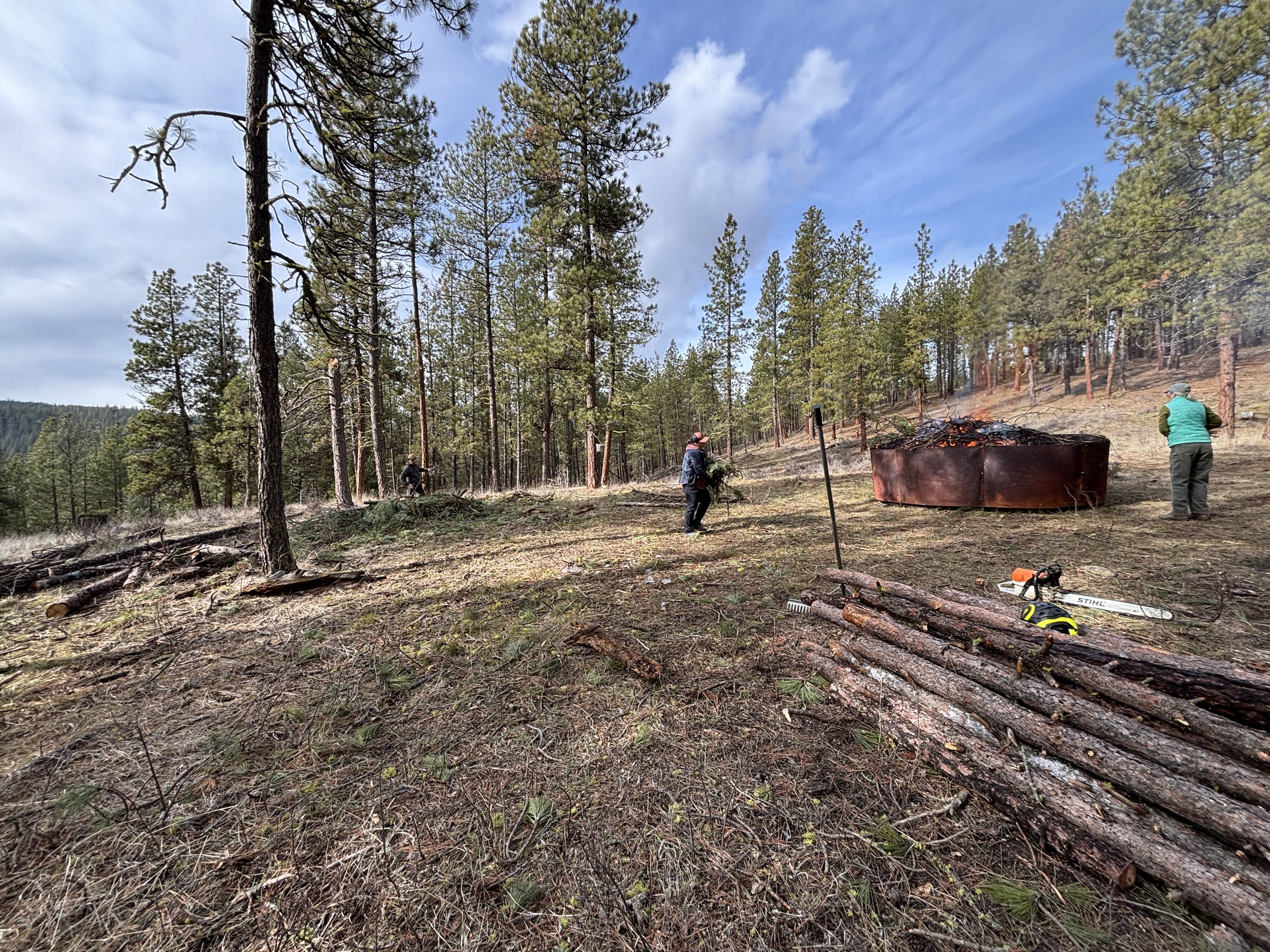
Rural Washington State landowners are sitting on an underused asset: forest biomass that needs to come off the land for fire and forest health reasons, but has few economic outlets once removed. Circular Spring saw an opportunity to turn that liability into a resource — using on-site biochar production to convert hazard fuels into a soil amendment with real market value, while keeping the economic benefit local rather than routing biomass to distant, centralized facilities.
Approach
As Principal Investigator, Circular Spring conceived and leads this $2MM project, partnering with CORRIM, Wilson Biochar, CHARR, and conservation districts across multiple Washington counties. We're applying our systems-based approach across the full stack: working directly with landowners to site and permit production, building workforce capacity for on-site kiln operation, and evaluating carbon credit protocols to establish a viable market mechanism for long-term implementation. Every decision is grounded in real landscapes, real partners, and real economic constraints — not a one-size-fits-all template.
Outcomes
This project is demonstrating that decentralized biochar production can function as genuine rural economic infrastructure — not just an environmental add-on. By pairing forest health treatment with a working economic model (workforce pathways plus carbon markets), Circular Spring is building a replicable pattern for how rural communities can turn wildfire risk reduction into lasting local value.